An expert guide to risks, safety protocols, and how to paddle one of Africa’s greatest wildernesses with confidence.
Heading Title
Yes — canoe safaris in the Okavango Delta are safe when guided by trained, experienced professionals who possess a deep understanding of wildlife behavior, waterway geography, and emergency protocols. Thousands of visitors paddle the Delta’s channels each year without incident. The key variable is not the activity itself, but the quality of guidance.dapibus leo.
The Okavango Delta, a UNESCO World Heritage Site sprawling across northern Botswana, is one of the world’s largest inland deltas — covering approximately 15,000 square kilometres during its annual flood. Unlike most safari destinations accessed by 4×4 or aircraft, vast sections of the Delta are navigable only by water. Mokoro (traditional dugout canoe) safaris have been the primary mode of transit for the BaYei people for centuries, and today form the foundation of one of Africa’s most sought-after ecotourism experiences.
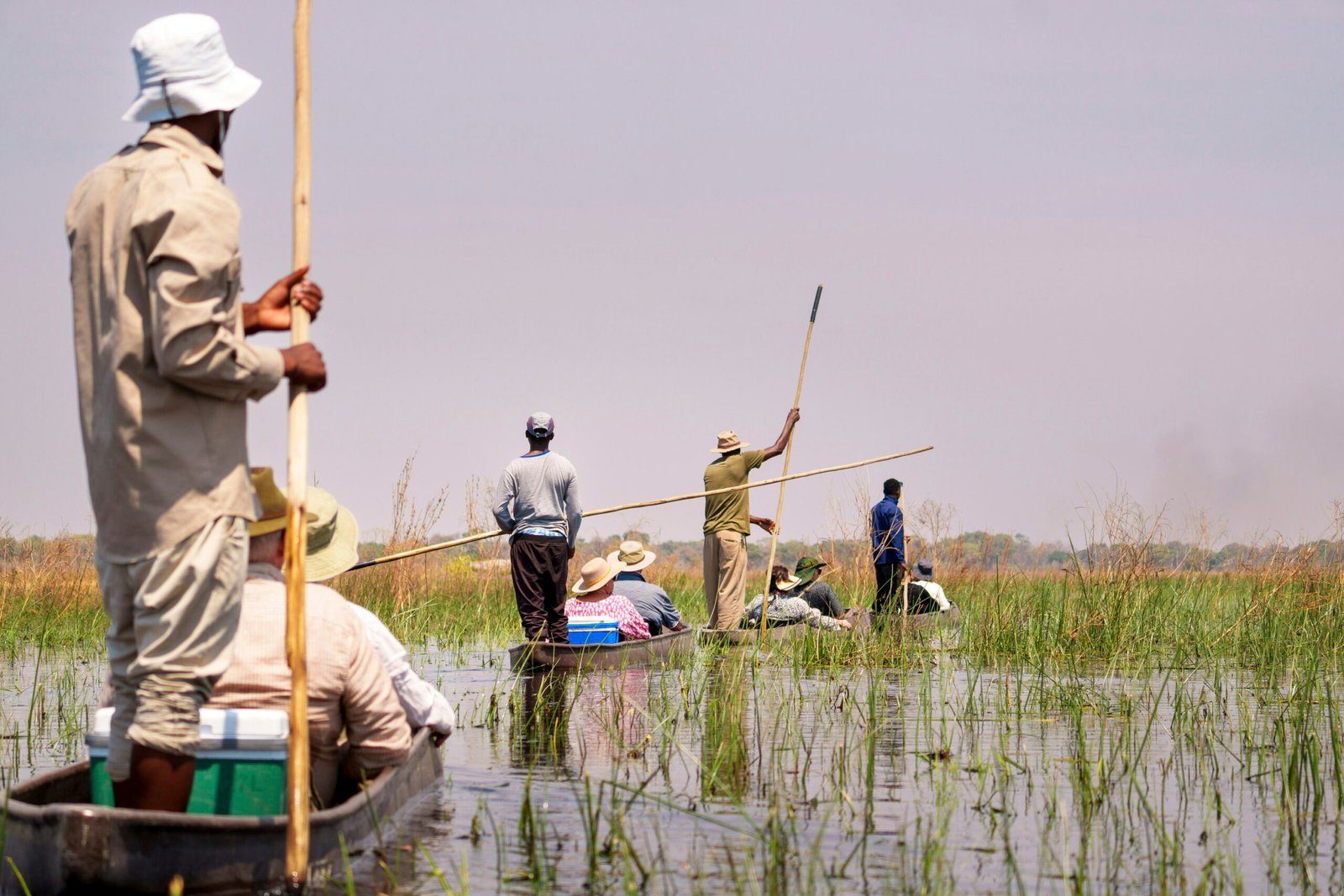
A mokoro is a shallow, flat-bottomed dugout vessel — originally carved from the trunk of a sausage tree or ebony, though most operators now use fibreglass replicas to reduce environmental impact. A single poler, called a ngaka, stands at the stern and uses a long pole to navigate channels, reed beds, and lily-covered lagoons in near-total silence. Guests sit low in the craft, at water level, drifting through papyrus corridors where elephants wade, sitatunga antelope pause, and malachite kingfishers dart overhead.
The experience is fundamentally different from any other safari format. You are not enclosed in a vehicle. You are not elevated on a viewing deck. You are in the water ecosystem, at animal eye level, enveloped by sound and stillness. That proximity is the appeal — and it is also the source of the activity’s most frequently asked safety question.
The Unique Risk: Hippos and the Logic of Close-Proximity Wildlife
The Okavango Delta supports one of Africa’s healthiest hippopotamus populations, with estimates suggesting between 10,000 and 15,000 individuals reside in the ecosystem. Hippos are responsible for more human fatalities in Africa than any other large mammal — not because they are aggressive by nature, but because they are extremely territorial in and around water, they move fast (reaching 30 km/h on land), and mokoro travel places guests in their primary habitat at close range.
This is not a theoretical risk. Hippo encounters at close quarters are a predictable feature of canoe safaris, and guides plan accordingly. The critical distinction is between a hippo sighting and a hippo encounter. Experienced polers read animal behaviour constantly — monitoring territorial bulls, noting the presence of calves (whose mothers are especially defensive), and identifying hippo pods by the sound of their exhalations before they become visible. A skilled ngaka will reroute, slow their approach, and withdraw quietly long before an animal registers distress.
Crocodiles represent a secondary but manageable risk. The Delta hosts a significant Nile crocodile population, but crocodile attacks on mokoro passengers are exceptionally rare. Crocodiles are ambush predators that assess threat before striking; they are not known to attack a mokoro in motion. Guides maintain awareness of basking crocodiles and avoid areas where large individuals are known to lurk near the waterline in confined channels.
Key Risk Comparison at a Glance
| RISK FACTOR | SEVERITY LEVEL | MITIGATION EFFECTIVENESS |
|---|---|---|
| Hippo encounter | High if provoked | Very High with guide expertise |
| Crocodile proximity | Moderate | High with safe paddling distance |
| Capsizing / drowning | Low to Moderate | High with life jackets & training |
| Getting lost in channels | Low | Very High with experienced guide |
| Dehydration / sunstroke | Moderate | High with proper preparation |
| Insect-borne illness | Low to Moderate | High with prophylaxis & DEET |
How Guides Manage Safety: The System Behind the Silence
Safety on a canoe safari is not passive. It is an active, ongoing process built on decades of accumulated local knowledge, formal training requirements, and strict operator protocols. Here is how each layer of risk is addressed in practice:
- Guide Qualification and Local Knowledge
Reputable operators require guides to hold certification from the Botswana Tourism Organisation (BTO) and complete structured wildlife behaviour and waterway navigation training. Many Delta polers are from communities who have worked these waterways for generations; their knowledge of seasonal hippo territories, crocodile nesting cycles, and flood-channel shifts is granular and irreplaceable. When booking a canoe safari, always confirm that your operator employs BTO-certified guides with demonstrable Delta experience — not simply individuals from adjacent regions.
- Pre-Departure Safety Briefings
All responsible operators conduct thorough safety briefings before departure. These cover: how to remain still in the mokoro, what to do in the event of a capsize, how to respond to wildlife signals from the guide, and the importance of following instructions without hesitation. Guests who understand the reasoning behind rules — why you do not trail your hand in the water, why you do not stand up suddenly, why silence matters — are safer guests.
- Route Selection and Daily Risk Assessment
Guides do not follow fixed routes. Channel conditions, animal movements, and flood levels change daily. Experienced polers conduct a mental risk assessment before every departure, choosing routes based on current wildlife positioning and guest experience level. Channels used by territorial hippo bulls are bypassed. Areas with recent crocodile activity near launch points are avoided. This dynamic routing is invisible to guests but is the single most important safety mechanism in play.
- Group Size and Supervision Ratios
Quality operators limit groups to manageable sizes — typically four to eight guests per outing, with a maximum of two guests per mokoro. An armed backup guide frequently accompanies larger groups on walking extensions from water camps, and radio communication with camp management is standard. Solo canoe travel without an experienced local guide is not offered by any reputable operator.
- Distance Management Protocols
A well-trained ngaka maintains a minimum safe distance from hippos at all times — generally no closer than 50 metres from a pod, and significantly more for isolated territorial bulls. Guides understand the difference between a hippo that has surfaced to breathe (relaxed) and one that has opened its mouth in a yawn display (a threat signal). Guests are instructed to remain still and low; guides manoeuvre quietly away using shallow pole strokes that minimise water disturbance.
Practical Safety Tips for Canoe Safari Guests
Beyond operator quality, individual guest behaviour significantly affects safety outcomes. The following tips come directly from the operational experience of Delta guides and camp managers:
- Stay calm and move slowly at all times in and around the mokoro. Sudden movements destabilise the craft and alarm nearby wildlife.
- Follow guide signals immediately and without question. A raised hand means stop. A pointed finger means look — do not stand. Verbal instructions are given quietly for a reason.
- Keep hands and feet inside the boat at all times when in open water or channels with crocodile activity.
- Do not carry uncovered food in the mokoro. Scent attracts wildlife and insects, both of which complicate navigation.
- Wear neutral, muted clothing — khaki, olive, or tan. Bright colours disturb wildlife and reduce the quality of close-range sightings.
- Apply high-strength DEET insect repellent and take prescribed malaria prophylaxis before entering the Delta. Mosquito-borne malaria remains the primary health risk for visitors to the Okavango.
- Wear a hat and apply SPF 50+ sunscreen. The Delta’s open water and cloudless skies create intense solar exposure, particularly between 10:00 and 14:00.
- Stay hydrated. Operators provide water, but inform your guide immediately if you feel unwell, dizzy, or overheated.
- Book with an operator affiliated with the Botswana Tourism Organisation and verified by recognised platforms such as Wilderness Safaris, &Beyond, or Okavango Expeditions. Avoid unvetted freelance operators offering significantly discounted rates.
When Is the Best and Safest Time to Do a Canoe Safari?
Safety and experience quality are both highest during the dry season flood peak, from approximately June to August. During this period, the annual Okavango flood — sourced from Angolan highlands rainfall — reaches its maximum extent, filling channels to navigable depth and concentrating wildlife around permanent water. Vegetation is lower, sightlines are clearer, animal behaviour is more predictable, and mosquito levels are substantially reduced compared to the summer wet season.
The wet season months (November to March) offer lush, green scenery and excellent birdlife, but come with higher mosquito density, reduced visibility in flooded reed beds, and increased unpredictability in hippo and crocodile movement. If this is your first canoe safari experience, dry season travel between June and August is strongly recommended.
Is a Canoe Safari Appropriate for Families and First-Time Safari-Goers?
Canoe safaris are well-suited to first-time visitors who are comfortable on water and capable of following instructions calmly. They are not high-adrenaline activities — the pace is slow, the atmosphere is meditative, and the wildlife encounters tend to be extraordinarily intimate rather than dramatic.
For families with children, most operators impose a minimum age of 12, occasionally 10, for mokoro travel. Young children who cannot remain still, quiet, and compliant with guide instructions introduce genuine risk — not from malice, but from developmental inability to manage the required behavioural constraints. Discuss age and temperament honestly with your operator before booking.
Guests with mobility limitations should also consult with operators in advance. Boarding and disembarking a mokoro requires agility; shallow water near reeds can make alternatives necessary. Most camps accommodate such guests through alternative water-based activities such as motorised boat transfers or elevated viewing platforms.
👉 FINAL VERDICT A canoe safari in the Okavango Delta is safe, peaceful, and profoundly unique — provided you book with a reputable operator, trust your guide completely, and approach the experience with calm respect for the wild. No other safari format places you so intimately within one of Africa’s most pristine ecosystems. The reward is extraordinary. The risks, properly managed, are minimal. |