
THE BOTTOM LINE — READ THIS FIRST
Safari attacks are rare but real. With approximately 3–5 million safari tourists visiting Africa each year, the industry records only 1–2 wildlife fatalities annually. The vast majority of incidents are preventable and share a common cause: tourists or operators ignoring safety rules. This article documents five verified, newsworthy incidents, extracts the specific mistakes made, and gives you a concrete safety checklist to ensure your safari is the adventure of a lifetime — not a tragedy.
Africa’s wilderness is not a theme park. When you step into the Luangwa Valley, cruise the Zambezi by canoe, or drive through Pilanesberg, you are a guest in an ecosystem governed by predator–prey dynamics that are billions of years older than tourism. The animals do not know you are on holiday.
That is not a reason to stay home. It is a reason to be prepared.
The incidents below are real, verified, and widely reported. Each one contains a lesson that experienced safari consultants teach clients before every trip. Read them not as cautionary tales designed to frighten you, but as briefings that could save your life.
Story 1: The Open Window — Katherine Chappell, South Africa, 2015
INCIDENT SUMMARY Lion Park, Gauteng, South Africa • June 1, 2015 • Source: CNN, Wikipedia, ABC News |
Katherine Chappell, 29, was a rising visual-effects editor whose credits included Game of Thrones, Captain America: The Winter Soldier, and Divergent. She had travelled to South Africa on a volunteer conservation mission and had arranged a game drive at Lion Park, a popular wildlife facility north of Johannesburg.
Chappell was a passenger in a vehicle driven by 66-year-old tour operator Pierre Potgieter. As the vehicle stopped to observe a pride of lions, Chappell rolled down her passenger window to take photographs. She did not notice a lioness approaching from the side. Witnesses in nearby vehicles honked their horns in warning. The lioness stopped approximately one metre from the vehicle, then lunged, biting Chappell through the open window and inflicting catastrophic injuries to her neck and chest.
Potgieter fought the animal off with his bare hands, suffering serious arm injuries and later a heart attack during the ordeal. An ambulance arrived within minutes. It was not in time. Chappell died at the scene.
Park management confirmed that warning signs were posted at the entrance and that a written notice was distributed to every vehicle — a copy of which was found, unread, on the passenger seat beside Chappell.
Source: CNN: Poised for Attack — Photo shows lion shortly before mauling woman to death
Source: Wikipedia: Katherine Chappell
What went wrong
- A single rule was broken: the car window was opened in an active lion enclosure.
- The park had communicated the rule clearly, in writing, at the point of entry.
- External warnings from other drivers were ignored because the subject was focused on photography.
- Lion Park used semi-habituated lions, which have reduced fear of humans, making them more likely to investigate and act on proximity.
The lesson
The vehicle is your safety cage. Its value is absolute and non-negotiable. In any vehicle-based game drive — whether in a national park or a commercial wildlife facility — windows remain up and doors remain closed unless a qualified guide specifically instructs otherwise. No photograph is worth compromising that boundary. Semi-habituated lions in commercial parks behave differently from their wild counterparts; the iconic Lion Whisperer Kevin Richardson noted at the time that park lions can lose their natural fear of humans, making rule compliance even more critical in such settings.
Story 2: The Canoe and the Hippo — Paul Templer, Zimbabwe, 1996
INCIDENT SUMMARY Zambezi River, Zimbabwe • March 9, 1996 • Sources: Wikipedia, CNN Travel, Washington Post |
Paul Templer was 28, a certified Zimbabwean safari guide with a rigorous training background, when he agreed at the last minute to lead a canoe expedition down the Zambezi River. His party included six paying clients (four Air France crew and a German couple) and three apprentice guides. The Zambezi is wide, powerful, and home to some of the densest hippopotamus populations on Earth.
The group encountered a pod of approximately a dozen hippos. Templer attempted evasive navigation, but the group was drawn closer. A submerged bull hippo surfaced beneath the canoe of apprentice guide Evans Namasango, capsizing it and throwing two passengers into the water. Namasango, in a profound act of heroism, used his oar to defend the panicking French and German tourists from the hippo while they swam to safety.
Templer paddled across to assist. The hippo struck, seizing Templer in its jaws and dragging him below the surface. By his own account, his head entered the animal’s throat. The hippo surfaced and released him, then attacked again. Templer sustained 38 serious bite wounds: a punctured lung, a torn Achilles tendon, and catastrophic arm injuries. Another guide, Mike, pulled Templer to a rock and improvised first aid using plastic wrap from a snack box to seal the back wound.
It took eight hours to get Templer to a hospital with adequate facilities. His left arm was amputated. Evans Namasango was never found alive; his body was recovered two days later, approximately one kilometre downstream.
Source: Wikipedia: 1996 Zambezi River hippopotamus attack
Source: CNN Travel: How a river guide survived a hippo attack
What went wrong
- The canoe route passed too close to a large hippo pod; safe navigation distance was compromised.
- The first aid kit, radio, and rifle were all lost when Namasango’s canoe capsized — a single-point-of-failure in equipment distribution.
- Medical evacuation infrastructure in remote Zimbabwe in 1996 was severely limited; eight hours elapsed before adequate care was available.
The lesson
Hippos kill more people in Africa than almost any other large mammal, yet tourists persistently underestimate them. They are almost entirely submerged, move silently, can hold their breath for five minutes, and run at 20 mph on land. When booking any water-based activity — canoe safari, boat cruise, river walk — verify that your operator distributes safety equipment across multiple vessels and has a tested emergency communication plan. Ask specifically: what happens if the radio or the rifle ends up in the river? Today, Templer is a professional speaker who urges people to “go, but go smartly” — paired with a professional who genuinely knows what they are doing.
Story 3: Off the Vehicle for a Photo — Pilanesberg, South Africa, 2024
INCIDENT SUMMARY Pilanesberg National Park, North West Province, South Africa • July 2024 • Sources: Newsweek, North West Parks & Tourism Board |
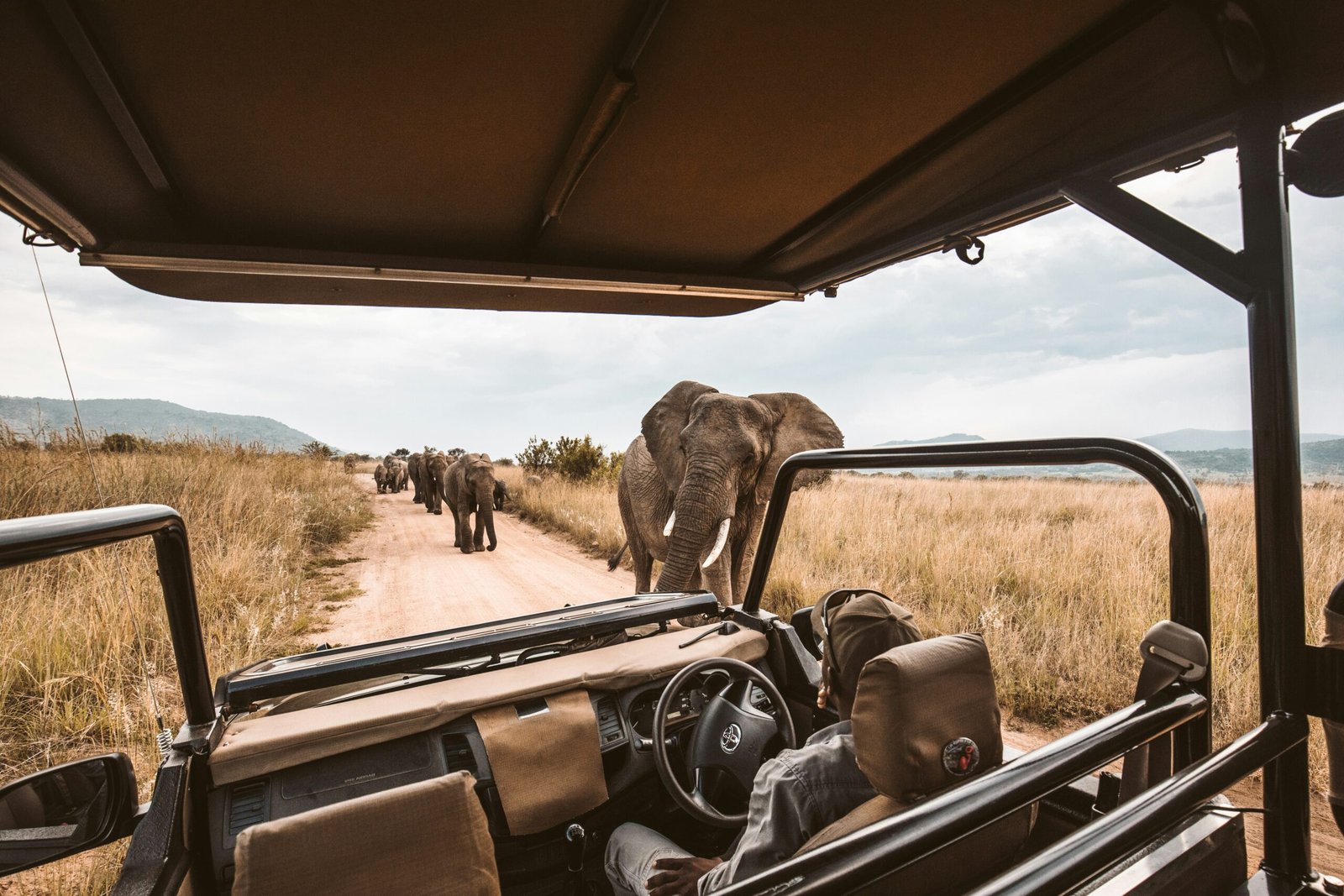
A male tourist visiting Pilanesberg National Park was on a self-drive safari with his fiancée and two other passengers when the group encountered three adult elephants and three calves beside the road. The man stopped the vehicle, opened the door, and walked toward the elephants to take photographs.
Passengers in his vehicle warned him to return. Occupants of two other nearby vehicles also shouted warnings. He did not respond. One of the adult cow elephants charged. The man ran but was caught and trampled. The remaining elephants joined the charge. He died at the scene.
The North West Parks and Tourism Board issued a formal statement: “Tourists are constantly reminded about the importance of staying inside their vehicles when visiting the park, and to keep a good distance between animals.” Park CEO Thami Matshego confirmed the warnings had been communicated and that the behaviour was a direct violation of park rules.
Source: Newsweek: Man on Safari Killed by Elephant After Leaving Car To Take Pictures
What went wrong
- The tourist exited the vehicle in the direct presence of elephants with calves — one of the highest-risk scenarios possible on safari.
- Multiple independent warnings from fellow travellers were disregarded.
- A female elephant protecting calves is statistically one of the most dangerous animals you can approach on foot.
- Self-drive safaris carry additional risk: there is no professional guide present to enforce or physically intervene.
The lesson
Elephant cows with calves are not docile. They are among the most protective animals on Earth and will charge without prolonged warning. The widely reported statistic that Zimbabwe alone recorded 50 human deaths from wildlife in a single year (2023) — the majority involving elephants — contextualises why park rules are not mere bureaucratic caution. On a self-drive safari, you are your own guide. That requires a higher, not lower, standard of discipline. The vehicle is not a viewing platform from which you can step for a better angle. It is the only barrier between you and a 6,000 kg animal.
Story 4: Bush Walk to the Riverbank — Lisa Manders, Zambia, 2024
INCIDENT SUMMARY Lower Zambezi National Park, Zambia • June 5, 2024 • Sources: NBC News, Connecticut Public, KIRO7 |
Craig and Lisa Manders, a couple from New Jersey, flew to Zambia on May 31, 2024, for a ten-day safari arranged through African Portfolio, a U.S.-based tour operator based in Greenwich, Connecticut. The actual in-country safari was operated by Chiawa Safaris. Five days into the trip, the couple joined a guided bush walk.
The guides led the group to a riverbank in the Lower Zambezi National Park, where a lone hippopotamus was resting in the water. Hippos resting alone are a known risk signal: solitary bulls are typically territorial and easily provoked. What happened next is contested between the lawsuit and the operator’s account.
According to the lawsuit filed in Stamford Superior Court by Craig Manders, the hippo charged from the water and seized Lisa Manders, crushing her head and body. Craig Manders witnessed the attack. The suit alleges that guides — including at least one armed with a rifle — failed to intervene and walked away. Lisa Manders, 70, died at the scene.
The operator stated that the guides were experienced, that safety measures were in place, and that repeated warnings were issued to guests to return to a vehicle during the incident. The litigation remains ongoing.
Source: NBC News: New Jersey man sues safari tour operator after rampaging hippo killed his wife
Source: Connecticut Public: Man whose wife was killed in a hippo attack in Africa sues CT company
What went wrong
- The group was led on foot to a riverbank where a solitary, territorial hippo was present.
- A lone hippo — as distinct from a family pod — is a recognised danger sign that experienced guides are trained to identify.
- Accountability between the U.S. booking agent and the in-country operator was unclear, creating a gap in safety responsibility.
The lesson
When you book a safari through a Western tour operator, your contract is with them, but your safety depends entirely on the in-country operator and guides. You must ask both parties the right questions before you depart. Verify the specific safari company on the ground, its guide accreditation, its emergency protocol for river and bush walk activities, and its medical evacuation insurance. The booking agent and the safari operator are not the same entity, and that distinction matters when something goes wrong.
Story 5: Mother Elephant and Calf — South Luangwa, Zambia, July 2025
INCIDENT SUMMARY South Luangwa National Park, Zambia • July 3, 2025 • Sources: CNN, CBS News |
This incident is among the most recent in a cluster of fatal elephant encounters that has drawn global attention to safari safety. Two women — Janet Taylor, 68, from the United Kingdom, and Alison Jean Taylor, 67, from New Zealand — were on a walking safari in South Luangwa National Park, one of Africa’s most celebrated wilderness areas and the historic home of the walking safari format pioneered by Norman Carr in the 1950s.
The group encountered a female elephant with a calf. Guides attempted to stop the elephant’s charge by firing shots and wounding the animal. They were unable to prevent the attack. Both women died at the scene.
This incident occurred less than twelve months after two American women — Juliana Gle Tourneau of New Mexico, 64, and Gail Mattson of Minnesota, 80 — were killed in separate elephant encounters in Zambia. All four victims were older women, prompting wildlife safety researchers to question whether more rigorous fitness and situational-awareness assessments should be required before walking safaris are approved for participants.
Source: CNN: Elephant kills two tourists from the UK and New Zealand in Zambian national park
Source: CBS News: Elephant kills 2 women from U.K. and New Zealand in Zambian national park
What went wrong
- A mother elephant with a calf is statistically one of the most dangerous animals to approach on foot, regardless of guide experience.
- Even with professional armed guides, a charging elephant at close range on a walking safari offers very limited reaction time.
- The cluster of incidents in Zambia from 2024–2025 suggests possible systemic issues: elephant behaviour changes driven by habitat compression, increased human–wildlife overlap, and tourism pressure.
The lesson
Walking safaris are not inherently unsafe, but they carry an irreducible residual risk that vehicle-based safaris do not. The statistics from the industry research platform Fauna Travel indicate that the years 2024–2025 have seen an abnormal clustering of fatalities, significantly above the 1–2-per-year average across the preceding two decades. If you are considering a walking safari, book only with operators who have a multi-decade safety record in that specific ecosystem, verify your guide’s qualifications independently, and accept that “no incidents in recent memory” is a meaningful standard, not a given.
Your Safari Safety Checklist: 10 Rules Derived from These Stories
These rules are not theoretical. Each one maps directly to a failure in one of the five incidents above.
- Rule 1: Keep all windows and doors closed in any vehicle-based safari, especially in lion, leopard, and cheetah zones. (Chappell, 2015)
- Rule 2: Never exit a vehicle except in a designated safe area under active guide supervision, with zero large mammals within visual range. (Pilanesberg, 2024)
- Rule 3: On water activities, confirm that safety equipment is distributed across multiple vessels, not centralised in one canoe. (Templer, 1996)
- Rule 4: Treat a lone hippo near water as an immediate danger signal. Do not approach. Retreat. (Manders, 2024)
- Rule 5: Always verify the in-country operator independently from the booking agent. They are different entities with different levels of training. (Manders, 2024)
- Rule 6: Treat any elephant with calves as maximally dangerous on a walking safari and maintain the greatest possible distance. (South Luangwa, 2025)
- Rule 7: Ask your operator for their specific emergency medical evacuation protocol before departure, including which hospital they use and how long transfer takes. (Templer, 1996)
- Rule 8: Read every safety briefing you are handed. Do not put it on the seat beside you. (Chappell, 2015)
- Rule 9: On a self-drive safari, apply the same rules a professional guide would. Your desire for a better photograph is not a justification for rule violation. (Pilanesberg, 2024)
- Rule 10: Select walking safari operators with a verified multi-decade safety record in the specific park and ecosystem you are visiting, not just generic Africa experience. (South Luangwa, 2025)
PUTTING RISK IN CONTEXT African safari tourism remains statistically safer than many popular holiday activities. Research published by Fauna Travel and peer-reviewed in the Journal of Travel Medicine (Durrheim et al., 1999) consistently shows that with 3–5 million safari visitors annually, wildlife fatalities average 1–2 per year. That is a fatality rate comparable to or lower than road travel in most major tourist cities. The cases documented here are rare, verifiable, and instructive — not representative of the typical safari experience, which ends with a lifetime of extraordinary memories. |
Go. But Go Prepared.
Safari is one of the most transformative travel experiences on Earth. The incidents documented above are tragedies — but they are also gifts of hard-won knowledge that you can apply before you ever board a flight to Nairobi or Lusaka.
The single most consistent finding across 25 years of safari safety data is that the animal is almost never the problem. The problem is the decision made by a human in the moments before the attack: a window rolled down, a car door opened, a riverbank approached on foot, a written warning left unread on a passenger seat.
African wildlife is magnificent precisely because it is wild, unscripted, and morally indifferent to our presence. Respect that reality, follow the rules without exception, choose your operator with the rigour you would apply to any serious safety decision, and Africa will give you everything it has promised.
This site exists to help you make that journey safely. Browse our operator vetting guides, destination safety ratings, and emergency planning resources before you book.